Intro
cert-manager has been issuing certificates since
Part 6
: Let’s Encrypt for
*.franzramadhan.dev, and a private lab CA for *.franzramadhan.lab. So I
assumed the homelab was “on TLS”. This morning I checked every endpoint to be
sure, including the internal ones.
The front doors were fine. What was behind them wasn’t: once a request got past the gateway, it often went on in plain HTTP, sometimes across the router from Part 25 . Postgres accepted logins without TLS. And every Kubernetes Secret was stored in etcd as plain text.
TL;DR: Every URL had a valid certificate, but TLS ended at the gateway. I turned on Cilium WireGuard for pod traffic between hosts, made lab-gateway’s port 80 a 301 to HTTPS, made Postgres reject non-TLS logins with a lab-CA server certificate, and encrypted Secrets in etcd with secretbox. Two traps cost me downtime: Cilium only picks up the change after an agent restart (about 1.5 minutes without a gateway each time), and k0s runs kube-apiserver as its own user, so a root-only key file kept two controllers down.
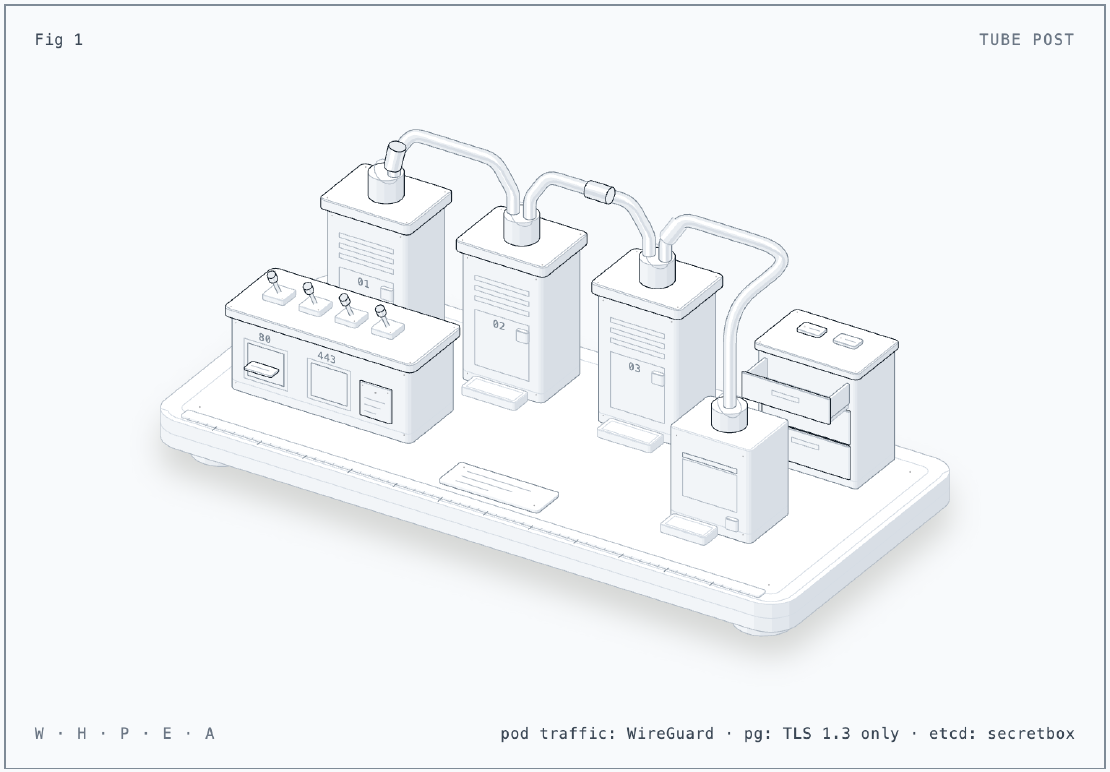
The Figure
The figure is an office tube post. The front counter is lab-gateway, with
hatch 80 and hatch 443 and the lab-CA certificate plate next to it. The three
stations at the back are the Proxmox hosts, and capsules travel between them
the way pod traffic crosses hosts. The box on the right is Postgres, and the
drawer cabinet is etcd. It starts in the old state: capsules travel open, the
Postgres box takes any capsule, and the drawer holds plain sheets. W seals
the capsules (WireGuard), H sends a slip from hatch 80 round to 443 (the
301), P makes the Postgres box drop open capsules into its reject tray, and
E files the Secrets in sealed envelopes, with the key’s two tags on the
cabinet. A flips everything at once. I generated it with the
anatomy
agent skill.
The Situation
- k0s v1.36.4: 3 controllers (etcd members) and 5 workers on 3 Proxmox hosts.
- Cilium 1.20.2: native routing, kube-proxy replacement, Gateway API.
lab-gatewayon192.168.101.152for the LAN, plus Tailscale Ingresses for the tailnet. - cert-manager with a
lab-caClusterIssuer: root CA valid until 2036, 90-day wildcard certificate for*.franzramadhan.lab. - CloudNativePG 1.30.1, cluster
pg(PostgreSQL 18.6), primary plus one replica on two hosts. - OpenBao for secrets, with External Secrets syncing them into Kubernetes Secrets.
The audit
I listed what can be reached and how:
kubectl get clusterissuers,certificates -A
kubectl get gateway -A -o json | jq ...            # listeners and their certs
kubectl get httproute,ingress -A
kubectl get svc -A --field-selector spec.type=LoadBalancer
Then I checked each URL against the lab CA itself, not by trusting the browser:
curl --cacert lab-ca.crt --resolve grafana.franzramadhan.lab:443:192.168.101.152 \
  -o /dev/null -w '%{http_code} verify=%{ssl_verify_result}\n' https://grafana.franzramadhan.lab/
# 302 verify=0
| Endpoint | TLS | Result |
|---|---|---|
kubernetes, grafana, pihole.franzramadhan.lab | lab-ca wildcard on lab-gateway | valid |
Headlamp, Grafana, OpenBao on *.ts.net | Tailscale’s certificates | valid |
| OpenBao API (in-cluster) | its own lab-ca certificate, into the pod | valid |
| lab-gateway port 80 | none | 404 for every host |
| Gateway to backends, pod to pod across hosts | none | plain HTTP |
Postgres pg | on, TLS 1.3 minimum | non-TLS logins still accepted |
| Secrets in etcd | none | plain |
| Proxmox UIs on :8006 | Proxmox’s own CA | not lab-ca (verify=20) |
The Postgres row surprised me. CloudNativePG turns SSL on and uses certificate
login for replication, but its last pg_hba rule is
host all all all scram-sha-256. host matches TLS and non-TLS alike.
flowchart LR
  B[Browser] -->|HTTPS| GW[lab-gateway<br/>Envoy on a worker]
  GW -->|HTTP| P1[Grafana pod<br/>other host]
  P1 -->|HTTP| VM[VictoriaMetrics<br/>other host]
  APP[App pod] -->|TLS optional| PG[(Postgres pg)]
  API[kube-apiserver] -->|plain| ETCD[(etcd)]
Issue 1: WireGuard on, but nothing encrypted
Symptom
The change was three lines of Cilium values:
encryption:
  enabled: true
  type: wireguard
  nodeEncryption: false   # pod traffic only; Tailscale also runs on the nodes
Flux applied it and the HelmRelease was Ready. cilium-config had
enable-wireguard: "true". Every agent still said:
cilium-dbg status | grep Encryption
# Encryption:              Disabled
Cause
The agents read cilium-config at start. Changing the ConfigMap doesn’t
restart them unless the chart’s rollOutCiliumPods is on, and it was off.
Fix
A rolling restart, then rollOutCiliumPods: true and
operator.rollOutPods: true in values so the next change restarts by itself:
kubectl -n kube-system rollout restart ds/cilium deploy/cilium-operator
cilium-dbg status | grep Encryption
# Encryption:  Wireguard  [NodeEncryption: Disabled, cilium_wg0 (Pubkey: ..., Port: 51871, Peers: 4)]
All five workers show four peers. The controllers aren’t Cilium nodes in k0s. Each peer had a recent handshake and traffic in both directions, between 245 and 436 KB per peer within the first minutes.
Side effect: 1.5 minutes without a gateway
Right after the restart, every HTTPS URL failed:
connect to 192.168.101.152 port 443 failed: Connection refused
The Service still pointed at Envoy’s listener, but Envoy had no gateway listeners until the new agent pushed them again. About 90 seconds later:
lds: add/update listener 'gateway/cilium-gateway-lab-gateway/listener'
It happened again on the second restart. On this cluster a cilium-agent restart means about 1.5 minutes without lab-gateway, so I now plan Cilium changes for quiet hours.
Issue 2: A ConfigMap key no upgrade would remove
Symptom
I also turned off Cilium’s Ingress controller, since everything uses the
Gateway API. Its LoadBalancer on .153 went away, but cilium-operator kept
logging:
failed to list *v1.Ingress: ingresses.networking.k8s.io is forbidden:
User "system:serviceaccount:kube-system:cilium-operator" cannot list resource "ingresses"
The chart had removed the operator’s Ingress permissions, but the live
cilium-config still said enable-ingress-controller: "true".
Cause
The chart no longer renders that key when the feature is off. The key
belongs to the field manager of the Helm CLI, which installed Cilium before
Flux took over (Part 16
). Server-side
apply only removes fields its own manager owns, so the key stayed. I hit the
same class of problem with Pi-hole in
Part 24
, where one upgrade with
serverSideApply: disabled fixed it. Here that didn’t help either. A
client-side three-way merge deletes fields that were in the previous
release’s manifest, and the key had already gone from that manifest in the
first upgrade.
Fix
Remove the key from the live object and restart only the operator, which doesn’t touch the gateway:
kubectl -n kube-system patch cm cilium-config --type=json \
  -p '[{"op":"remove","path":"/data/enable-ingress-controller"}]'
kubectl -n kube-system rollout restart deploy/cilium-operator
HTTP to HTTPS
Before, port 80 on lab-gateway answered 404 for everything. Now one
HTTPRoute on the http listener redirects:
apiVersion: gateway.networking.k8s.io/v1
kind: HTTPRoute
metadata:
  name: https-redirect
spec:
  parentRefs:
    - name: lab-gateway
      sectionName: http
  hostnames:
    - "*.franzramadhan.lab"
    - "*.franzramadhan.dev"
  rules:
    - filters:
        - type: RequestRedirect
          requestRedirect:
            scheme: https
            statusCode: 301
curl -s -o /dev/null -w '%{http_code} -> %{redirect_url}\n' http://grafana.franzramadhan.lab/
# 301 -> https://grafana.franzramadhan.lab:443/
Postgres: TLS or nothing
No app uses the cluster yet, so this was the cheapest moment to make it
strict. Two changes: a server certificate from the lab CA, so clients can use
sslmode=verify-full, and pg_hba rules that turn non-TLS away.
apiVersion: cert-manager.io/v1
kind: Certificate
metadata:
  name: pg-server
spec:
  secretName: pg-server
  secretTemplate:
    labels:
      cnpg.io/reload: "true"   # PostgreSQL reloads when cert-manager renews
  usages: [server auth]
  dnsNames: [pg-rw, pg-rw.databases.svc, pg-ro, pg-ro.databases.svc, ...]
  duration: 2160h
  issuerRef: {kind: ClusterIssuer, name: lab-ca}
# Cluster pg
certificates:
  serverTLSSecret: pg-server
  serverCASecret: pg-server
postgresql:
  pg_hba:
    - hostnossl all all all reject
    - hostssl all all all scram-sha-256
CloudNativePG put both rules ahead of its default host rule and applied
them with a reload: no restart and no failover. Replication keeps
CloudNativePG’s own client CA and certificate login. From the replica pod to
pg-rw:
psql "host=pg-rw.databases.svc dbname=homelab user=homelab sslmode=disable"
# FATAL:  pg_hba.conf rejects connection for host "10.0.0.160", user "homelab", database "homelab", no encryption
psql "host=pg-rw.databases.svc dbname=homelab user=homelab sslmode=verify-full sslrootcert=server-ca.crt" \
  -c "select ssl, version from pg_stat_ssl where pid = pg_backend_pid()"
# t | TLSv1.3
Issue 3: The key file kube-apiserver couldn’t read
Encrypting Secrets at rest is a kube-apiserver flag,
--encryption-provider-config, pointing at a file that holds the key. In
k0s, flags go into spec.api.extraArgs. kube-apiserver is a host process on
each controller, so the file has to be on all three.
apiVersion: apiserver.config.k8s.io/v1
kind: EncryptionConfiguration
resources:
  - resources: [secrets]
    providers:
      - secretbox:
          keys:
            - name: key-2026-10-17
              secret: <32 random bytes, base64>
      - identity: {}   # existing plain Secrets stay readable
Before turning it on, the key went to two places: OpenBao, and a break-glass file on my laptop. OpenBao runs inside this cluster. If the cluster is broken badly enough to need the key, OpenBao may be down too.
Symptom
I rolled the controllers one at a time. On controller-01, k0s restarted and the API never came back:
error reading encryption provider configuration file "/etc/k0s/encryption-config.yaml":
open /etc/k0s/encryption-config.yaml: permission denied
Cause
k0s runs kube-apiserver as its own user:
id kube-apiserver
# uid=994(kube-apiserver) gid=986(kube-apiserver)
I had written the file as root, mode 0600, which was right for a key and
unreadable for the process that needs it. My next step repeated the mistake
on controller-02, because the sed command meant to fix my script failed and I
didn’t stop to check. Each time the other two controllers kept etcd quorum and
the API, so the cluster stayed up.
Fix
chown kube-apiserver:root /etc/k0s/encryption-config.yaml
chmod 400 /etc/k0s/encryption-config.yaml
# readyz 401 (anonymous off, so: up) after 9 seconds
After each controller, the gate: [+]etcd ok, three etcd members, and
k0s’s controller count back at 3. Then all existing Secrets get rewritten, so
they’re stored again under the new provider:
kubectl get secrets -A -o json | kubectl replace -f -
# 120 replaced
k0s doesn’t ship etcdctl, so I asked etcd directly over its v3 HTTP API
with the apiserver’s client certificate:
curl -s --cacert pki/etcd/ca.crt --cert pki/apiserver-etcd-client.crt --key pki/apiserver-etcd-client.key \
  https://127.0.0.1:2379/v3/kv/range -d "{\"key\":\"$(printf /registry/secrets/databases/pg-server | base64)\"}"
# value starts with: k8s:enc:secretbox:v1:key-2026-
Result
| Before | After | |
|---|---|---|
| Pod traffic between hosts | plain | WireGuard (cilium_wg0, UDP 51871) |
| lab-gateway port 80 | 404 | 301 to HTTPS |
Unused Ingress LB .153 | listening | removed |
| Postgres logins | TLS optional | TLS only (TLS 1.3), lab-CA server cert |
| Secrets in etcd | plain | secretbox |
flowchart LR
  B[Browser] -->|HTTPS| GW[lab-gateway]
  GW -->|WireGuard between hosts| P1[Grafana pod]
  P1 -->|WireGuard| VM[VictoriaMetrics]
  APP[App pod] -->|TLS 1.3 required| PG[(Postgres pg)]
  API[kube-apiserver] -->|secretbox| ETCD[(etcd)]
Not done:
- Disk encryption. LUKS on the VM disks or the hosts needs a key at every boot, and the cluster starts on its own at 06:00 every morning. A key on the same disk protects nothing. I’ll encrypt backups instead when they go to S3.
- Proxmox UIs still use Proxmox’s own CA. Lab-CA certificates for them are a separate host-level job.
Lessons
- A certificate on the front door says nothing about the hallway. Check where TLS ends, not only that it starts.
- Read the running state, not the config.
cilium-configsaid WireGuard was on. The agents said it wasn’t. - Know what a restart costs. Here a Cilium agent restart means about 1.5 minutes without a gateway, so Cilium changes now go to quiet hours.
- Fields from an old Helm CLI owner can outlive every upgrade mode. Once the chart stops rendering a key, neither apply mode removes it.
- Check which user reads a secret file. Root-only is the safe default and
still wrong when the reader is
kube-apiserver. - Store an encryption key twice before turning encryption on, and once outside the system it protects.
- Fix a script before running it again. One unchecked sed turned one controller outage into two.
Series
This post is part of Homelab Rebuild:
- Part 1: Upgrading Proxmox VE 8 to 9
- Part 2: Starting Over When the IaC Is Broken
- Part 3: When Tailscale Breaks Your Cilium Gateway
- Part 4: Living on the Tailnet
- Part 5: Secrets Without Secrets in Git
- Part 6: Certificates, DNS and a Private CA
- Part 7: Self-Hosted CI and Getting Back to IaC
- Part 8: Stateful Workloads on Unequal Hardware
- Part 9: Going Public Safely with Cloudflare Tunnel
- Part 10: When the Hypervisor Went Quiet
- Part 11: Hardening the Cluster in Five Layers
- Part 12: Observability with Coroot, and Losing pve-01
- Part 13: The Host That Kept Losing Power
- Part 14: Observability, Take Two with OpenTelemetry
- Part 15: Requests and Limits for Everything
- Part 16: Handing the Cluster to FluxCD
- Part 17: Making the Guardrails Earn Their Keep
- Part 18: When the API Server Outgrew Its VM
- Part 19: Logging In to OpenBao with Cloudflare Access and Google
- Part 20: Headlamp SSO, or Teaching kube-apiserver to Trust Cloudflare Access
- Part 21: pve-02 Loses Power, and Pi-hole Has Nowhere to Go
- Part 22: Turning Four Days of Fixes into AI Runbooks
- Part 23: microVM Sandboxes on Proxmox
- Part 24: Pi-hole Without a Home Host
- Part 25: It Was the Router
- Part 26: TLS on the Front, Plaintext Behind It
- Part 27: One Bad Power Adapter, Two Different Deaths