Intro
For four days my two ThinkCentre hosts kept dying. pve-01 went first (Parts 12 and 13 ): resets every few minutes, a POST hang, then silence. Swapping its power adapter with pve-02’s stopped it. A day later pve-02, now on pve-01’s old adapter, started dying too (Part 21 ), but in a completely different way.
This post puts the whole thing in one place: what each host did, how the logs pointed at the adapter and not at the disks, and what the new adapter shows so far.
TL;DR: One worn adapter, two failure modes. On pve-01 it caused instant resets with zero disk errors. On pve-02 it caused a slow brown-out: the SATA SSD degraded and detached, the host hung for 14 to 52 minutes, then dropped. pve-02’s SSD had 0 errors in 34 boots over 16 months on its own adapter and errors in every boot on the bad one. On a new adapter it has logged 0 errors so far (about 16 hours on 2026-10-17 morning). Not final yet: on the bad adapter the first error took 27 hours.
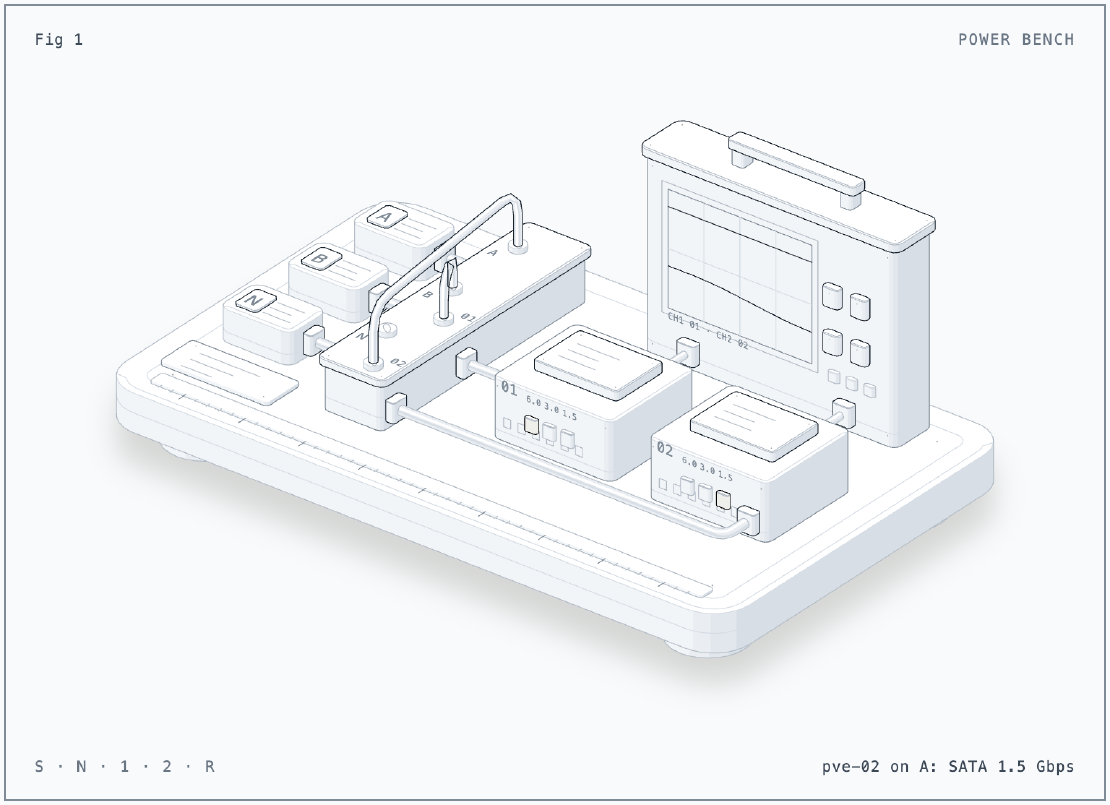
The Figure
The figure is a test bench. Bricks A, B and N on the left are the power
adapters: A is the worn one, B is pve-02’s own, N is the new one. Patch cords
on the panel decide which brick feeds which mini PC, 01 (pve-01) or 02
(pve-02). Each PC has its SATA SSD on top and three lamps on the front for
the link speed, and the scope at the back draws one supply trace per PC. It
starts with A on pve-01: the trace drops to zero at once and the SSD lamp
never moves. S swaps A and B: on pve-02 the trace sags, the link steps
down from 6.0 to 3.0 to 1.5 Gbps, then goes dark. N puts the new brick on
pve-02, 1 and 2 pick the host the readout follows, and R starts over.
I generated it with the anatomy
agent skill.
The Situation
- pve-01 and pve-02: Lenovo ThinkCentre M715q Tiny (Ryzen 5 2400GE), each on its own external power adapter (same model).
- Storage in each: an NVMe drive (Proxmox, VM disks) and a Samsung 870 EVO
1TB SATA SSD (
ata1). - Proxmox VE 9 cluster with a third host (pve-03, a laptop) for quorum.
- Alloy on every host ships kernel logs to Grafana Cloud, outside the cluster.
- Timeline:
- 2026-10-13 and 10-14: pve-01 resets, POST hang, power-loss loop.
- 2026-10-14 06:49: adapters swapped between pve-01 and pve-02.
- 2026-10-15: pve-02 dies five times.
- 2026-10-16 16:57: pve-02 on a new adapter.
Issue 1: pve-01 died instantly
Symptom
On pve-01’s old adapter, the journal stopped mid-line, with no shutdown sequence and nothing from the kernel. The 10-14 morning was a loop of boots lasting 0 to 1 seconds. Once the board hung at POST until the CMOS was cleared.
What the disks said
Nothing. I searched every crash boot from 10-13 and 10-14 (77 boots in the journal back to 10-12) for SATA trouble:
for b in $(journalctl --list-boots --no-pager | awk '{print $1}'); do
  printf '%s ' "$b"
  journalctl -k -b "$b" --no-pager \
    | grep -cE 'exception|hard resetting|limiting|IDENTIFY|detaching|reset failed'
done
Zero error lines in every crash boot. ata1: SATA link down appeared only in
three boots, while the SSD was unplugged on purpose to reach the CMOS
battery. The SSD on pve-01 never complained about the bad adapter.
Issue 2: pve-02 died slowly
Symptom
pve-02 ran 27 hours on pve-01’s old adapter without an error. Then, on 10-15, it died five times. Before each death the SATA SSD degraded in the same order:
ata1: limiting SATA link speed to 3.0 Gbps
ata1: limiting SATA link speed to 1.5 Gbps
ata1.00: limiting speed to UDMA/33:PIO4
ata1.00: failed to IDENTIFY (I/O error, err_mask=0x100)
ata1: SATA link down (SStatus 0 SControl 310)
ata1.00: detaching (SCSI 0:0:0:0)
Then the host hung, and only much later did the cluster notice it was gone.
Hang, then drop
journald writes to disk every 5 minutes, so a clean power cut loses at most 5 minutes of journal. Here, the journal ended long before corosync on the other hosts lost pve-02:
| Death | SSD detached | Journal ends | Corosync loses pve-02 | Gap |
|---|---|---|---|---|
| 1 (nobody noticed) | 10:00:20 | 10:07:20 | 10:58:26 | 51 min |
| 2 | 11:09:27 | 11:10:14 | 11:27:29 | 17 min |
| 3 | 11:51:27 | 12:55:47 | 13:48:07 | 52 min |
| 4 | errors from 18:21:45 | 18:26:24 | 18:40:37 | 14 min |
| 5 | 19:22:09 | 19:43:29 | 20:02:28 | 19 min |
The first one only showed up later in journalctl --list-boots: the host had
reset itself at 10:58:55, after 51 minutes of hanging, and rejoined before
anyone looked.
There was no crash record. pstore was empty, and there were no machine-check lines. The AMD reset-reason register, which the kernel prints at boot, said the board went down through a soft-off, not a reset:
x86/amd: Previous system reset reason [0x00200800]: ACPI power state transition occurred
SMART on the SSD said it was healthy: 0 reallocated sectors, 0 uncorrectable errors, 0 CRC errors. One number stood out, though: 20 unexpected power losses in 48 power cycles.
Was it the SSD?
That was my first reading, and it’s the obvious one: the SSD fails first every time. The SSD’s own history says otherwise. pve-02’s journal keeps every boot back to June 2025, all with the same drive:
| Boots | Period | Adapter | ata1 error lines |
|---|---|---|---|
| 34 boots | 2025-06-09 to 2026-10-14 06:49 | its own | 0 |
| 1 boot | 2026-10-14 06:52 to 10-15 10:07 | pve-01’s old one | 41 |
| 4 boots | 2026-10-15 | pve-01’s old one | 7, 10, 5 and 15 |
Sixteen months clean, then errors in every single boot from the day the adapter arrived. The disk didn’t change. The power did.
Cause
A worn adapter doesn’t always cut out cleanly. Under load its voltage can sag. On pve-02 the most sensitive part was the SATA SSD, so it failed first. The kernel then hung waiting for the drive, and finally the board browned out to soft-off. On pve-01 the same adapter caused hard resets instead. Why one board resets and the other sags, I can’t tell from the logs: it could be load, board tolerance or the drive. I won’t claim more than the logs show.
The red herring: pve-01’s SSD failed on a good adapter
On 10-16, after pve-02 got its new adapter, pve-01 (on pve-02’s original, good adapter) booted clean at 16:57. Three minutes later, during a VM start, its own 870 EVO threw hundreds of errors:
ata1.00: exception Emask 0x0 SAct 0x400002ff SErr 0x0 action 0x6 frozen
ata1.00: failed to IDENTIFY (I/O error, err_mask=0x4)
ata1: limiting SATA link speed to 3.0 Gbps
By 17:15 every read returned DID_BAD_TARGET and the storage on that drive
was gone. Unlike pve-02, the host itself stayed up. I drained its Kubernetes
workers, shut it down and power-cycled it without reseating anything. It came
back at 6.0 Gbps with SMART passing, and the drive has been clean since.
That adapter had run pve-01 for 31 hours without a single error, so this event doesn’t fit the adapter story. It could be a one-off drive or controller hang, the drive itself, or its connection: I had unplugged that SSD twice for CMOS clears on 10-13. It’s on the watch list, not in the verdict.
Fix
A new adapter for pve-02 on 2026-10-16. The worn one is out of use.
An alert before the drop. A Grafana Cloud rule watches the hosts' kernel logs for SATA and NVMe trouble. On pve-02 these errors came 15 to 50 minutes before each drop, which is time to act:
count_over_time({job="integrations/node_exporter"}
  |~ `ata[0-9.]+: (failed to IDENTIFY|reset failed|limiting SATA link speed|hard resetting link)|nvme[0-9]+: (I/O|controller is down|Abort|timeout)|I/O error, dev` [10m]) > 0
I removed
SATA link downfrom the pattern: pve-03 logs it at every boot for an empty port.A gate on the morning start. pve-02’s VMs only come back at 06:00 when the disk log is clean. A one-shot timer counts ata1 errors before it turns the start timer back on. It counted 0 and turned it on.
Verdict, observed so far
Checked on 2026-10-17 at 09:08 WIB, per boot:
for b in -1 0; do journalctl -k -b $b | grep -ciE 'ata1.*(fail|error|link down|detach)'; done
| Host | Adapter | Since | ata1 errors | Link |
|---|---|---|---|---|
| pve-02 | new | 10-16 16:57 (2 boots, about 16 h) | 0 | 6.0 Gbps, UDMA/133 |
| pve-01 | pve-02’s original | 10-16 17:46 (about 15 h) | 0 | 6.0 Gbps, UDMA/133 |
pve-02 rebooted once in that window, on purpose, during an unrelated LAN problem (Part 25 ).
So far everything points at the adapter. It isn’t proven yet. On the bad adapter, the first error came after about 27 hours, so the new one has to pass that mark, around 2026-10-17 20:00 WIB, and then keep going. If an error shows up, the alert fires, and the drive, its cable or the port is next. I’ll add the result here either way.
Lessons
- Compare when the journal ends with when the network goes. A gap longer than journald’s sync interval means a hang, not a power cut.
- Keep the boot history. 34 clean boots on the same disk is what turned “the SSD is dying” into “the power is bad”.
- The first component to fail isn’t always the cause. The SATA SSD was the most sensitive part, not the broken one.
- Swap one variable. Moving the adapter moved the fault. Moving nothing else is what made that convincing.
- Look for the outage nobody noticed.
journalctl --list-bootsfound a death that had already healed itself. - Leave room for the event that doesn’t fit. pve-01’s SSD failure on a good adapter is still open, and calling it part of the adapter story would have been easier and wrong.
- Say “so far” until the evidence covers the time it took to fail.
Series
This post is part of Homelab Rebuild:
- Part 1: Upgrading Proxmox VE 8 to 9
- Part 2: Starting Over When the IaC Is Broken
- Part 3: When Tailscale Breaks Your Cilium Gateway
- Part 4: Living on the Tailnet
- Part 5: Secrets Without Secrets in Git
- Part 6: Certificates, DNS and a Private CA
- Part 7: Self-Hosted CI and Getting Back to IaC
- Part 8: Stateful Workloads on Unequal Hardware
- Part 9: Going Public Safely with Cloudflare Tunnel
- Part 10: When the Hypervisor Went Quiet
- Part 11: Hardening the Cluster in Five Layers
- Part 12: Observability with Coroot, and Losing pve-01
- Part 13: The Host That Kept Losing Power
- Part 14: Observability, Take Two with OpenTelemetry
- Part 15: Requests and Limits for Everything
- Part 16: Handing the Cluster to FluxCD
- Part 17: Making the Guardrails Earn Their Keep
- Part 18: When the API Server Outgrew Its VM
- Part 19: Logging In to OpenBao with Cloudflare Access and Google
- Part 20: Headlamp SSO, or Teaching kube-apiserver to Trust Cloudflare Access
- Part 21: pve-02 Loses Power, and Pi-hole Has Nowhere to Go
- Part 22: Turning Four Days of Fixes into AI Runbooks
- Part 23: microVM Sandboxes on Proxmox
- Part 24: Pi-hole Without a Home Host
- Part 25: It Was the Router
- Part 26: TLS on the Front, Plaintext Behind It
- Part 27: One Bad Power Adapter, Two Different Deaths (this post)