Intro
I want to run some of my own small services as WebAssembly modules on the k0s
cluster, next to the normal containers. A Mirantis blog post walks through
exactly that on k0s. You build the runwasi shims (small helper processes that
let containerd start Wasm modules). Then you drop a containerd config file into
/etc/k0s/containerd.d/, add a RuntimeClass, and you are done. So I had two questions:
does the guide work on my cluster, and which Wasm runtime do I pick?
The guide’s mechanism is right, but two things in it do not work on a current k0s. The second one cost me most of a morning.
TL;DR: use the prebuilt, signed runwasi Wasmtime shim and a containerd drop-in (an extra config file that containerd imports). On k0s 1.36 (containerd 2.x), the runtime goes under
io.containerd.cri.v1.runtime, not the containerd 1.x path that most guides show. Also build your Wasm images aslinux/amd64, notwasip1/wasm. Kubelet pulls with the host platform. So it pulls awasip1/wasmimage but never unpacks it, and the pod dies withparent snapshot ... does not exist.
The Figure
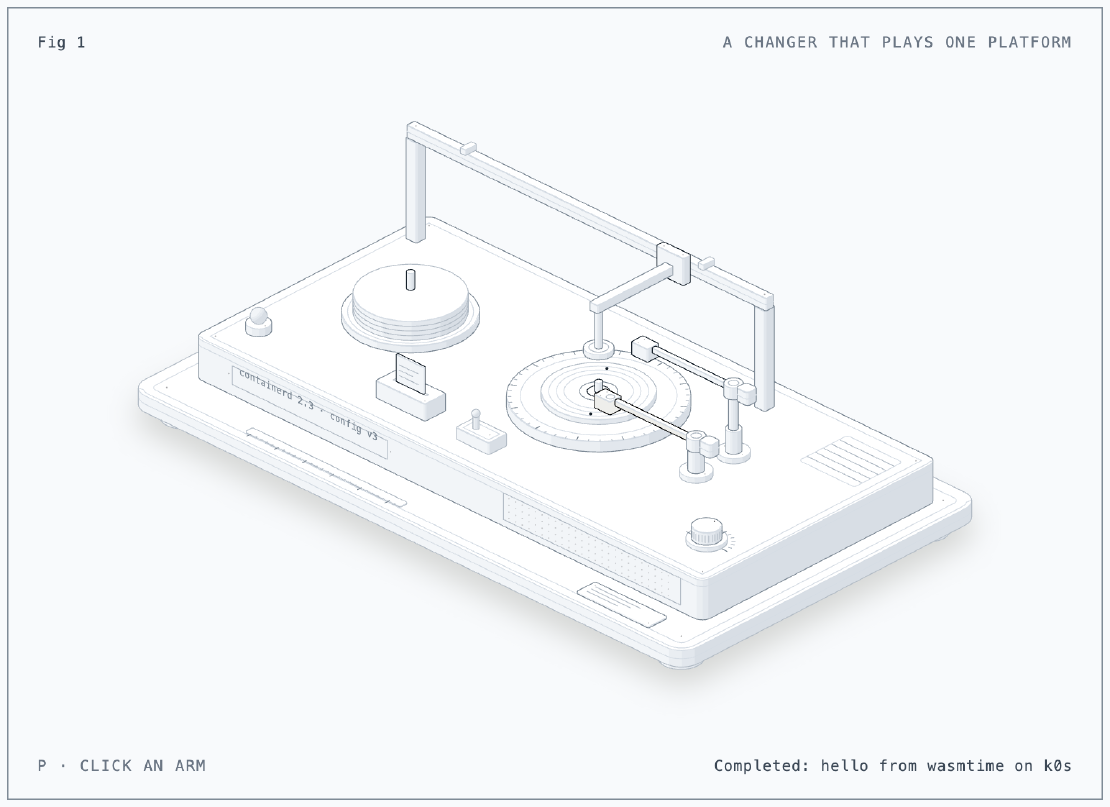
The figure is a jukebox drawn as a record changer. Each record is an image,
and its label is the platform. The carriage on the overhead rail is kubelet
and CRI. They pull with the default platform, so the carriage only lifts a
linux/amd64 record onto the platter (the unpacked snapshot). A wasip1/wasm
record stays in the magazine and the lamp beside it lights, because the image
pulled but never unpacked. Two tonearms stand at the right of the platter:
runc at the back and wasmtime in front. runtimeClassName picks one. The card
in the slot is the drop-in wasmtime.toml. The small greyed switch is
RuntimeClassInImageCriAPI, still alpha and off. Press P or click the
record to flip the platform. Click an arm (or press R/W) to pick the
runtime. wasip1/wasm fails with parent snapshot does not exist on either
arm. linux/amd64 on wasmtime prints hello from wasmtime on k0s and
reaches Completed. linux/amd64 on runc gets exec format error.
Built with the anatomy skill.
The Situation
k0s v1.36.4+k0s.1 on 5 Debian 13 workers and 3 controllers, data dir
/opt/lib/k0s. Workers run thek0sworkerservice.k0s ships containerd 2.3.5 with its own config in
/etc/k0s/containerd.toml. That file isversion = 3and has one line that matters here:imports = ["/etc/k0s/containerd.d/*.toml"]The directory existed and was empty.
The cluster is locked down: Kyverno denies workloads in
default, rejects:latestimages, and FluxCD owns every manifest.The source guide (Mirantis t0 blog, January 2026) builds runwasi from source with a Rust toolchain on the node. It writes a drop-in for both Wasmtime and WasmEdge. Then it restarts
k0scontrolleron a single node that is both controller and worker.
Picking a Runtime
The guide installs two shims, Wasmtime and WasmEdge. I only want one.
| Wasmtime | WasmEdge | |
|---|---|---|
| Backed by | Bytecode Alliance | CNCF sandbox project |
| WASI preview 2 and component model | first to ship, reference implementation | catching up |
| Extras | none I need | WASI-NN and LLM plugins, own socket extensions |
| Fits my plans | Rust is the main source (wasm32-wasip1 / wasip2) | AI already goes through LiteLLM |
I picked Wasmtime. To add WasmEdge later, I need one more drop-in file and one more RuntimeClass.
Setup
No Rust on the nodes
runwasi publishes a static musl build of each shim on its releases page, so I do not have to compile anything. The tarball also carries a keyless sigstore signature (a signature tied to the CI identity, with no long-lived key) from the runwasi release workflow. I checked it before I put a binary next to containerd:
shasum -a 256 -c <<< "a9b1215ee670f11414c8fd8e970b52679085929c8ec73a0fe6ed9cf215cf9ba1  containerd-shim-wasmtime-x86_64-linux-musl.tar.gz"
# containerd-shim-wasmtime-x86_64-linux-musl.tar.gz: OK
cosign verify-blob \
  --certificate containerd-shim-wasmtime-v1.pem \
  --signature containerd-shim-wasmtime-v1.sig \
  --certificate-identity-regexp '^https://github.com/containerd/runwasi/' \
  --certificate-oidc-issuer https://token.actions.githubusercontent.com \
  containerd-shim-wasmtime-v1
# Verified OK
That is containerd-shim-wasmtime v0.6.1: one 31 MB static binary,
containerd-shim-wasmtime-v1, copied to /usr/local/bin on each worker.
Rolling it out one worker at a time
On each worker, I copied the shim and the drop-in and restarted k0sworker.
Then I waited for the node to be Ready, made sure that nothing on it stopped,
and moved to the next worker.
scp containerd-shim-wasmtime-v1 root@<worker>:/usr/local/bin/
scp wasmtime.toml root@<worker>:/etc/k0s/containerd.d/
ssh root@<worker> systemctl restart k0sworker
kubectl wait --for=condition=Ready node/<worker> --timeout=180s
# ready after 6s
Every worker was Ready again in 5 to 6 seconds. Running pods keep running through a containerd restart because each container lives under its own shim process. The only noise in the journal was kubelet failing to look up a few old, already dead containers.
A k0s node has no crictl. To see what containerd actually loaded, I asked
containerd itself for its merged config:
/opt/lib/k0s/bin/containerd --config /etc/k0s/containerd.toml config dump | grep wasmtime
# [plugins.'io.containerd.cri.v1.runtime'.containerd.runtimes.wasmtime]
#   runtime_type = 'io.containerd.wasmtime.v1'
Issue 1: The Guide’s Config Is for containerd 1.x
Symptom
Nothing happens, and that is the problem. The guide’s drop-in looks like this:
[plugins."io.containerd.grpc.v1.cri".containerd.runtimes.wasmtime]
runtime_type = "io.containerd.wasmtime.v1"
Cause
That is the containerd 1.x CRI plugin path. containerd 2.x split the CRI
plugin and moved runtimes to io.containerd.cri.v1.runtime, with config
version = 3. If a table uses a plugin name that no longer exists, containerd
ignores it and raises no error. So containerd never registers the runtime, and
a RuntimeClass that points at wasmtime has no handler behind it.
Fix
Write the drop-in for config version 3:
version = 3

[plugins."io.containerd.cri.v1.runtime".containerd.runtimes.wasmtime]
  runtime_type = "io.containerd.wasmtime.v1"
config dump then shows the runtime, as above.
Issue 2: The Image Pulls, Then the Pod Cannot Start
For the test, I ran the runwasi demo module in a pod with a RuntimeClass that
points at the wasmtime handler. Kyverno first refused it twice, both times
correctly:
no pods in default, and no :latest. So I used a throwaway namespace and
pinned wasi-demo-app:0.2.0 by digest.
Symptom
Pulled   Successfully pulled image "ghcr.io/containerd/runwasi/wasi-demo-app:0.2.0@sha256:1a5e..." in 3.679s. Image size: 2265395 bytes.
Failed   Error: failed to create containerd container: parent snapshot sha256:5e2740... does not exist: not found
Kubelet pulls the image. Then containerd cannot find the filesystem that the image must unpack into.
Cause
The manifest was ordinary: one application/vnd.oci.image.layer.v1.tar
layer. The image config was not:
curl -sL -H "Authorization: Bearer $TOK" "$REGISTRY/blobs/$CONFIG_DIGEST" | jq -c '{os,architecture,ep:.config.Entrypoint}'
# {"os":"wasip1","architecture":"wasm","ep":["/wasi-demo-app.wasm"]}
The CRI plugin of containerd downloads the content. Then it unpacks the layers
into a snapshot (the unpacked filesystem that a container starts from) for one
platform. By default, that is the host platform, linux/amd64. A
wasip1/wasm image matches nothing. So the content is in the store, but
containerd never makes a snapshot, and container create fails on the missing
snapshot.
flowchart LR
  K[kubelet PullImage] -->|no runtime handler| C[containerd CRI]
  C --> P{image platform<br/>= linux/amd64?}
  P -->|yes| U[unpack to snapshot] --> S[create container on wasmtime]
  P -->|"no (wasip1/wasm)"| X["content only, no snapshot<br/>parent snapshot does not exist"]
Dead end: tell containerd the platform per runtime
containerd 2.x has a setting for exactly this. Its CRI config source has
RuntimePlatforms, which maps a runtime to the platform that its images use.
[plugins."io.containerd.cri.v1.images".runtime_platforms.wasmtime]
  platform = "wasip1/wasm"
config dump showed it loaded. Same error. The mapping only applies when
containerd knows which runtime an image pull is for. Kubelet only sends that
information with the RuntimeClassInImageCriAPI feature gate. That gate became
alpha in Kubernetes 1.29, and it is still alpha and off by default in 1.36.
I will not turn on an alpha kubelet gate on every worker for this.
Dead end: pre-pull by hand
k0s ctr images pull --platform wasip1/wasm failed with
no unpack platforms defined, because the transfer service only unpacks for
the host platform too. The client-side pull, --local, did work, and the pod
then ran:
hello from wasmtime on k0s
exiting
That proved the shim and the drop-in work. But pre-pulling images on every node by hand is not a way to deploy anything.
Fix
The Wasmtime shim does not care about the platform label. It looks at the
container’s entrypoint, sees a .wasm module, and runs it. So the image only
has to be an image that kubelet unpacks: a scratch image with the module in
it, built for linux/amd64.
FROM scratch
COPY wasi-demo-app.wasm /wasi-demo-app.wasm
ENTRYPOINT ["/wasi-demo-app.wasm"]
docker build --platform linux/amd64 -t wasi-demo-amd64:0.2.0 .
The image is a 636 KB tarball. I imported it on the worker and ran it through the normal kubelet path:
wasi-amd64   0/1   Completed   0   11s
linux-amd64 wasm image, normal unpack
exiting
Without the alpha gate, the runtime_platforms mapping does nothing, so I
removed it. Then I ran the test again: still Completed.
Making It Stick
Node side, in the cloud-init snippet that builds every worker VM: the drop-in is a
write_filesentry, and the shim download is pinned by sha256. I did a dry run of the snippet’s commands on a worker, and it caught one more thing. The tarball’s members are./containerd-shim-wasmtime-v1, with a leading./. Sotar -x ... containerd-shim-wasmtime-v1saysNot found in archive. With the./, it produces a binary identical to the installed one.Cluster side, a Flux app with one cluster-scoped object:
apiVersion: node.k8s.io/v1
kind: RuntimeClass
metadata:
  name: wasmtime
handler: wasmtime
The shim is on every worker, so it needs no scheduling block.
The last check ran on a different node through the Flux-owned RuntimeClass:
Completed, with the module’s output in the pod log.
A Wasm pod in this cluster now looks like any other pod with one extra line,
runtimeClassName: wasmtime. It still goes through the same Kyverno rules
(own namespace, pinned image, securityContext, requests and limits).
Lessons
- Check which containerd your distribution ships before copying a config
snippet. containerd 2.x moved the CRI plugin, and the old path fails
silently.
containerd config dumpshows what containerd actually loaded. - “Successfully pulled” is not “unpacked”. CRI unpacks for one platform. An image built for another platform stays in the content store. The error only shows up at container create, as a missing snapshot.
- Build Wasm images as
linux/amd64until kubelet can tell containerd the runtime. That needsRuntimeClassInImageCriAPI, still alpha in 1.36. The shim reads the entrypoint, not the platform label. - Prebuilt and signed beats building on the node. The workers need no Rust toolchain, the snippet pins the sha256, and a sigstore check ties the binary to the runwasi release workflow.
Series
This post is part of Homelab Rebuild:
- Part 1: Upgrading Proxmox VE 8 to 9
- Part 2: Starting Over When the IaC Is Broken
- Part 3: When Tailscale Breaks Your Cilium Gateway
- Part 4: Living on the Tailnet
- Part 5: Secrets Without Secrets in Git
- Part 6: Certificates, DNS and a Private CA
- Part 7: Self-Hosted CI and Getting Back to IaC
- Part 8: Stateful Workloads on Unequal Hardware
- Part 9: Going Public Safely with Cloudflare Tunnel
- Part 10: When the Hypervisor Went Quiet
- Part 11: Hardening the Cluster in Five Layers
- Part 12: Observability with Coroot, and Losing pve-01
- Part 13: The Host That Kept Losing Power
- Part 14: Observability, Take Two with OpenTelemetry
- Part 15: Requests and Limits for Everything
- Part 16: Handing the Cluster to FluxCD
- Part 17: Making the Guardrails Earn Their Keep
- Part 18: When the API Server Outgrew Its VM
- Part 19: Logging In to OpenBao with Cloudflare Access and Google
- Part 20: Headlamp SSO, or Teaching kube-apiserver to Trust Cloudflare Access
- Part 21: pve-02 Loses Power, and Pi-hole Has Nowhere to Go
- Part 22: Turning Four Days of Fixes into AI Runbooks
- Part 23: microVM Sandboxes on Proxmox
- Part 24: Pi-hole Without a Home Host
- Part 25: It Was the Router
- Part 26: TLS on the Front, Plaintext Behind It
- Part 27: One Bad Power Adapter, Two Different Deaths
- Part 28: Observability, Take Three: Making It Worth Looking At
- Part 29: One Meter for Every Model, LiteLLM on Workers AI
- Part 30: Proxmox Joins the SSO, and a Plan Token Loses Admin
- Part 31: First Backups, Postgres, OpenBao and etcd to R2
- Part 32: Alerts That Reach Me, Even When the Lab Is Dead
- Part 33: The Firewall Held, the Tailnet Did Not
- Part 34: From Watching to Blocking, and a Record of Who Did What
- Part 35: Wazuh Without the 8 GB, Endpoint Security for One Mac and Three Hosts
- Part 36: The Fans Were Loud, the CPUs Were Idle
- Part 37: A Power Trip, a Search Domain and a Wildcard
- Part 38: An Autonomous AI Pentester in a Sealed Box
- Part 39: Wasm Pods on k0s, and the Label That Kept Them Packed (this post)
References
- Mirantis t0: Running WebAssembly Workloads on k0s: A Complete Guide
- GitHub: containerd/runwasi
- containerd: CRI Plugin Config Guide
- Kubernetes: Feature Gates (RuntimeClassInImageCriAPI)
- Kubernetes: Runtime Class
- k0s: Runtime (containerd) configuration
- Bytecode Alliance: Wasmtime
- GitHub: wheresryan22/anatomy