Intro
Most subnet calculators give you the numbers and stop there: network,
broadcast, host range. That is fine when you already know why a /22 starts
at 10.0.0.0 and not at 10.0.1.0. It does not help when you are still
learning, and most people I know are still learning IPv6. The rules for ::,
why a LAN is always a /64, and what fe80:: does on every interface all
feel arbitrary. That changes when someone maps them back to IPv4 habits.
So I wrote ipcalc, a calculator where every value comes with a short “why”. I put it on the internet at ipcalc.franzramadhan.dev. It was also the excuse I needed for a real workload on the Wasm runtime that I added to my cluster shortly before (Part 39).
TL;DR: ipcalc is one WebAssembly component (
wasi:http/incoming-handler, 356 KB) written in Rust, with no filesystem, no outbound network, no database and no logs. Each pod uses 6 MiB of memory. The catch was the WASI version. The runwasi Wasmtime shim serves WASI 0.2.6, and the Rustwasm32-wasip2target already imports 0.2.12, so the component did not start. So I build it forwasm32-wasip1and wrap it with the Wasmtime 36 proxy adapter instead. The build fails if any import is too new. Source and a free JSON API: github.com/franzramadhan/ipcalc (MIT).
The Figure
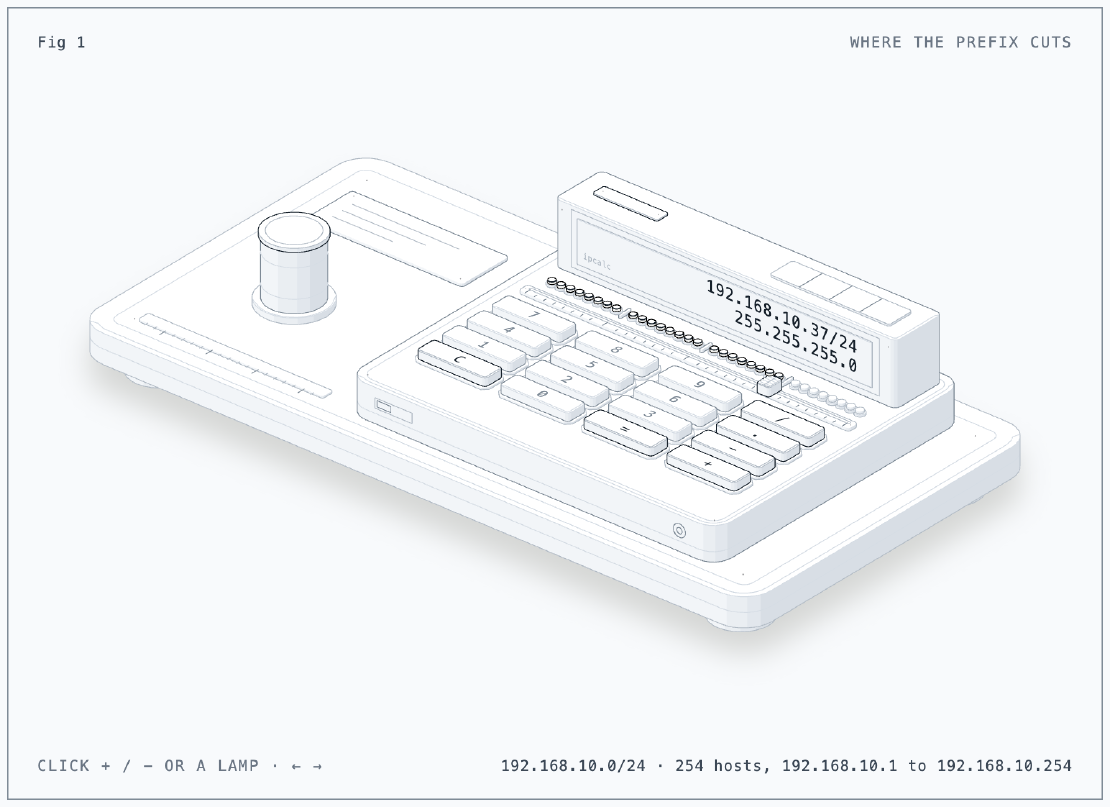
The figure is a desk calculator with a row of 32 lamps above the keypad: the
address 192.168.10.37 in binary, eight lamps to an octet. The slide on the
rail is the prefix length. Every lamp left of it is a network bit and is lit.
Every lamp right of it is a host bit. Press + or − (or the arrow keys) to
move it. The mask on the display and the range and host count in the readout
follow it. These are the same answers that ipcalc gives with its “why”. I
built it with the anatomy skill (see References).
What It Does
- Explain takes any address with an optional prefix. It shows the
network, range, mask and wildcard, address type, IPv6 compression, EUI-64
(a host ID made from the MAC address), multicast scope and embedded IPv4.
It can split the block (a
/22into/24s, a/56into/64s). Explain my IP does it for the address you connect from. - Inside? checks whether an address or subnet is inside a network. It shows the masking step that a router does. It also explains why IPv4 is never inside IPv6 (IPv4-mapped, NAT64).
- Summarize takes up to 64 subnets. It returns the exact minimal set of prefixes, the single supernet, and how many extra addresses that supernet also covers.
- IPv4 vs IPv6 is a cheat sheet: each IPv4 habit and its IPv6 version.
- API documents the JSON API the page itself uses.
The answer sits in a card on top, and every row below it carries its “why”.
Under each result there is Ask your own AI: a prompt built from the
verified values, to paste into any chat model. The model then explains
instead of recomputing. Models still get :: and prefix boundaries wrong
often, so I do not trust their math. Each result also shows the curl
command for the same answer:
curl -s 'https://ipcalc.franzramadhan.dev/api/v1/contains?net=10.0.0.0/22&ip=10.0.1.77' \
  | jq -r '.facts[] | select(.label == "Result").value'
# inside
ipcalc stores nothing you type. Explain my IP reads the Cloudflare
CF-Connecting-IP header and shows it back only to you.
The Situation
- ipcalc 0.2.4, Rust 1.99,
wstd0.6.8 for the HTTP server,serde_json, nothing else at runtime. 19 tests, 97% line coverage. - Runtime: the runwasi
containerd-shim-wasmtimev0.6.1 on k0s 1.36, behind RuntimeClasswasmtime(Part 39). The shim is built on Wasmtime 36. - Image:
FROM scratchwithipcalc.wasmas the entrypoint, built aslinux/amd64(Part 39 explains why notwasip1/wasm). - Edge: Cloudflare in front, the same public gateway and tunnel as the Homie demo.
I looked at Zig first, because I like it for small binaries. But it has no
toolchain for the component model (the WebAssembly standard for typed
interfaces between modules) yet. A wasi:http component needs the component
model, so I used Rust.
How a Request Gets Served
flowchart LR
  U[Browser or curl] --> CF[Cloudflare<br/>WAF rate limit on /api/]
  CF -->|06:00 to 23:30| T[Tunnel] --> GW[public gateway] --> P[ipcalc pod<br/>wasmtime shim]
  CF -->|23:30 to 06:00| W[Offline Worker<br/>503 page or JSON]
The pod has no web server in the usual sense. The shim loads the component
and calls its incoming-handler export once per request, on port 8080. The
component routes the path to plain Rust functions. Because of that, I can
test the routing natively with cargo test, without Wasm in the loop.
The pod spec looks like any other pod in the cluster, with one extra line:
spec:
  runtimeClassName: wasmtime
  containers:
    - name: ipcalc
      image: ghcr.io/franzramadhan/ipcalc:0.2.4@sha256:...
      resources:
        requests: {cpu: 10m, memory: 16Mi}
        limits: {cpu: 200m, memory: 64Mi}
      securityContext:
        runAsNonRoot: true
        readOnlyRootFilesystem: true
        capabilities: {drop: ["ALL"]}
The same Kyverno rules apply as for every container (pinned image, requests and limits, the securityContext above), and the shim accepts all of it. The CiliumNetworkPolicy allows ingress on 8080 and lists no egress peers at all. So the pod cannot reach anything, not even DNS. It does not need to.
$ kubectl -n ipcalc top pod
NAME                     CPU(cores)   MEMORY(bytes)
ipcalc-97c8dcd8d-79wk6   1m           6Mi
ipcalc-97c8dcd8d-fbrtw   1m           6Mi
I switch the lab off at night. While it is off, a Cloudflare Worker serves
a short notice page instead. API calls get a JSON error with HTTP 503 and a
Retry-After header, so scripts know when to try again.
Issue 1: The Component Did Not Start
Symptom
The first build was for the Rust wasm32-wasip2 target. In the cluster, the
pod failed at start:
component imports instance `wasi:http/types@0.2.12`, but a matching implementation was not found in the linker
Cause
A component declares the exact WASI version of every interface it imports.
The host must provide that version or a newer one. The shim v0.6.1 is
built on Wasmtime 36, which serves WASI 0.2.6. The Rust wasm32-wasip2
standard library already imports 0.2.12. So pinning crates in
Cargo.toml cannot fix it: the newer imports come from std itself.
Dead end: a newer shim
The Spin shim v0.26.0 is on Wasmtime 48, which serves 0.2.12. But it brings the SpinKube operator and its own app format. That is a lot of extra machinery for one calculator. runwasi itself is still on Wasmtime 36.
Fix
I build a plain WASI preview 1 module and turn it into a component myself. I use the adapter from the same Wasmtime version that the shim uses:
flowchart LR
  S[Rust source] -->|cargo build<br/>wasm32-wasip1| M[core module]
  M -->|wasm-tools component new<br/>Wasmtime 36 proxy adapter| C[component]
  C --> K{imports newer<br/>than 0.2.6?}
  K -->|yes| F[build fails]
  K -->|no| I[scratch image<br/>linux/amd64]
The HTTP bindings come from the wasip2 crate pinned to =1.0.1, which is
WASI 0.2.4. build.sh pins the adapter file by sha256. The last step lists
the component’s imports with wasm-tools. It fails the build if any of them
is newer than 0.2.6. So if a crate update pulls in a newer WASI, it breaks
the build on my laptop and not the pod in the cluster. When runwasi moves to
a newer Wasmtime, this goes back to a plain wasm32-wasip2 build.
Issue 2: The New Tabs Did Not Work for Visitors
Symptom
Version 0.2.1 replaced the single long page with tabs. On my machine, the tabs worked. For anyone who opened the page before, the page looked stuck: a click on a tab showed nothing.
Cause
The HTML was new but app.js was not. The component sent assets with
max-age=300. But the Cloudflare browser cache setting for the zone stretches
that to a day. So browsers kept the old script and ran it against the new
markup.
Fix
Version 0.2.2 links the assets as /app.js?v=0.2.2. The component fills in
its own crate version at request time, so every release changes the URL. The
component sends the HTML itself with no-cache, so the new URLs arrive right
away. A test makes sure that the page carries the current version.
Issue 3: One Answer Was Off by a Factor of Two
Symptom
Summarizing 2001:db8::/64 and 2001:db8:0:ff::/64 gives the supernet
2001:db8::/56. The page said it covers “about 2^71” extra addresses.
Cause
The supernet holds 2^72 addresses and the inputs 2^65, so the extra is 2^72 minus 2^65, about 2^71.98. I rounded the log down. That turned “almost 2^72” into 2^71.
Fix
I round to the nearest power of two now, which gives 2^72. A test keeps it there. The “why” column exists to show exactly this kind of mistake: the explanation said 2^72 minus 2^65 in the same row.
Lessons
- A Wasm component is pinned to a WASI version, and so is your host. Before you pick a Rust target, find out which Wasmtime your shim is built on. Fail the build on newer imports, so you do not find out at pod start.
- Version your asset URLs as soon as a CDN is in front. A short
max-agefrom the origin is a suggestion. The edge can stretch it. - Wasm is a good fit for small, stateless HTTP services. It is 356 KB and uses 6 MiB of memory, with no filesystem and no network to lock down. The pod still goes through the same policies as every container.
References
- GitHub: franzramadhan/ipcalc
- GitHub: containerd/runwasi
- GitHub: bytecodealliance/wasm-tools
- Wasmtime: Adapters for WASI preview 1
- WASI: wasi:http
- crates.io: wstd
- GitHub: wheresryan22/anatomy