Intro
People send me links and files on Telegram and WhatsApp. Some of them are phishing. I wanted one simple habit for all of them: forward the thing to a bot, and get an answer back. The answer must come from a machine that can break without hurting anything, and that machine must reset itself after every check.
This post covers the detonation sandbox (an isolated VM where an untrusted link or file can run). The parts are two microVMs, the jail inside them, the evidence the hosts keep, the n8n workflow that drives them, and the Telegram relay in front. It also covers the errors on the way.
TL;DR: Two microVMs, 830 on pve-01 and 840 on pve-02, have internet access only. A Proxmox firewall group blocks the LAN, the tailnet and the cluster. Inside, every job runs as an unprivileged user behind three layers: a
systemd-runseccomp jail, an extra filter for io_uring, and nono 0.81.0 (Landlock plus a logging proxy). The host records a pcap and the serial console from outside the VM and uploads them to R2. After each job the VM rolls back to the snapshotcleanin about 3 s. A relay pod polls the Telegram bot. A web link opens in headless Chromium in the VM and comes back as a screenshot, a verdict and the hosts it contacted. A file, or a link that serves a file, is hashed and looked up on VirusTotal. If VirusTotal does not know it, the VM pulls it from R2 into the jail, and the bot reports what nono saw. The script that runs the sample is not in the VM image yet.
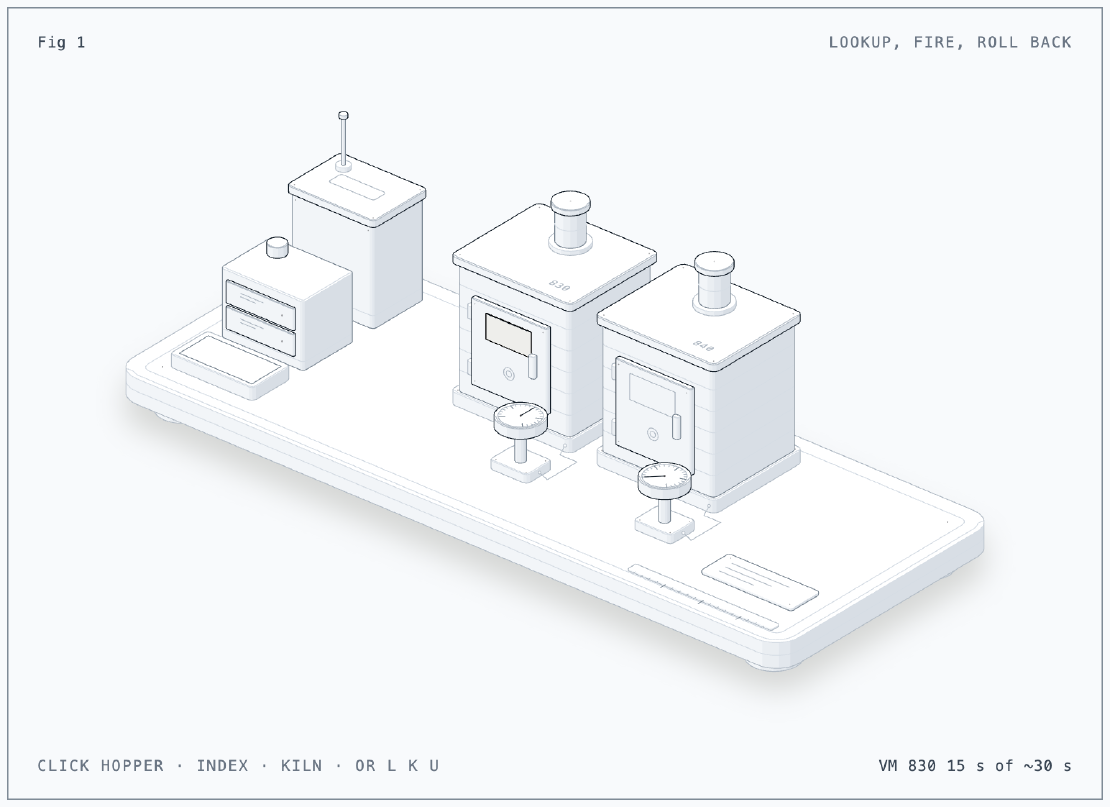
The figure is a twin test kiln. Each kiln is one VM, and its door window
lights while a job runs. After the job, the kiln rolls back to the snapshot
clean. The hopper with the antenna is the relay that polls Telegram. A web
link goes straight to a kiln. A file goes to the card index first, which is
the VirusTotal lookup, and a known hash drops into the tray with its verdict.
The dial in front of each kiln is the capture that the host keeps from
outside the VM. Click the hopper, the card index or a kiln to send a link, a
known file or an unknown file. I built it with the anatomy skill (see
References).
The Situation
- Proxmox VE 9.2 on pve-01, pve-02 and pve-03, pve-microvm 0.4.1
(QEMU
microvmmachine type) on pve-01 and pve-02 - Guest: Debian 13, kernel 6.12.113, systemd 257.13, Chromium 156.0.8078.79, Node 20.19.2
- n8n 2.45.7 in the k0s cluster, behind oauth2-proxy on the tailnet only (see part 41)
- Cloudflare R2 for evidence and samples, LiteLLM for the summary line
- Telegram bot that already sends my Grafana alerts
The flow for one message:
flowchart LR
  T[Telegram bot] -->|getUpdates| R[tg-inbox relay]
  R -->|web page| F[n8n form: Detonation URL check]
  R -->|file| V[VirusTotal hash lookup]
  V -->|unknown| S[R2 samples/]
  S --> F
  F --> VM[VM 830 or 840: jail + nono]
  VM --> F
  F -->|screenshot or report| T
  VM -.->|pcap, serial| E[R2 evidence/]
Setup
Two VMs that see only the internet
VMs 830 (192.168.101.83) and 840 (192.168.101.84) are clones of the
microVM templates: 2 GiB, 2 vCPU, 8 GB disk, tag no-autostart. A firewall
group detonation in cluster.fw drops everything to private ranges and
allows DNS to 1.1.1.2 and the internet. Each VM also has ipfilter and
macfilter on, so a sample cannot spoof another address. A check script
confirmed this from inside both VMs. Every LAN, tailnet, cluster, SMTP and
other DNS target is closed. 1.1.1.2:53 and 1.1.1.1:443 are open, and a
spoofed .99 source gets nothing back.
The jail
The job runs as user detonate through /opt/detonate/jail, a wrapper
around a transient systemd unit:
systemd-run --quiet --pipe --wait --collect --service-type=exec \
  -p User=detonate -p NoNewPrivileges=yes -p CapabilityBoundingSet= \
  -p SystemCallFilter=@system-service landlock_create_ruleset landlock_add_rule landlock_restrict_self \
  -p SystemCallFilter=~@privileged @mount @module @reboot @swap @raw-io @clock @debug @obsolete @keyring \
  -p RestrictAddressFamilies="AF_UNIX AF_INET AF_INET6" -p RestrictNamespaces=yes \
  -p ProtectSystem=strict -p ProtectHome=yes -p ReadWritePaths="/work /var/lib/detonate/.local/state/nono" \
  -p ProtectProc=invisible -p ProcSubset=pid -p MemoryMax=1G -p TasksMax=256 -p RuntimeMaxSec=300 \
  -- /opt/detonate/enosys nono run --allow /work --read /opt/detonate --deny-domain blocked.invalid -- <job>
nono adds Landlock (a kernel feature that limits which paths a process can
open) and a proxy for all traffic. --deny-domain blocked.invalid turns the
proxy on but allows every real host, so every connection lands in nono’s
session.json with its decision, target and port. The sample cannot write to
that file. Only nono can.
A blocked syscall kills the process instead of returning EPERM. The kernel
then logs a line like audit: type=1326 ... syscall=425 to the serial
console, and the host keeps that line.
Evidence on the host
A Proxmox hookscript starts a tcpdump on the VM’s tap device and a reader
on its serial socket. After the VM stops, it uploads both to
evidence/<vmid>/<timestamp>/ in the R2 bucket detonation-reports with
curl --aws-sigv4 aws:amz:auto:s3. The guest cannot touch any of it. A
lifecycle rule deletes samples/ after 1 day and everything after 30 days.
A token that can only drive two VMs
n8n uses the API token detonator@pve!n8n, with a role on /vms/830 and
/vms/840 only: VM.Audit, VM.PowerMgmt, VM.Snapshot.Rollback,
VM.GuestAgent.Audit and VM.GuestAgent.Unrestricted. agent/exec needs
the last one. With this token, cluster/resources lists only the two VMs.
Requests for the status of another VM, a clone, a new snapshot or a config
change all return 403.
The n8n workflow
“Detonation URL check” takes a form submission:
- Pick 830 if it is stopped, else 840, else reply “busy”.
- Start the VM and wait for the guest agent.
agent/execa bash script. The URL goes in as$1, never inside the shell string.- Poll
exec-status, thenfile-readof/work/result.json: exit code, nono’s events, a base64 screenshot and the log tail. - Stop the VM and roll back to
clean, also on every error path. - Drop the calls that Chromium makes to Google hosts on its own.
- Apply the verdict rules. An exit code other than 0 gives “needs a look”. Any nono denial gives “suspicious”. Anything else gives “no red flags”, which does not prove that the target is safe.
- Ask LiteLLM for a 3-line summary of the facts only.
- Send the screenshot with the verdict to Telegram.
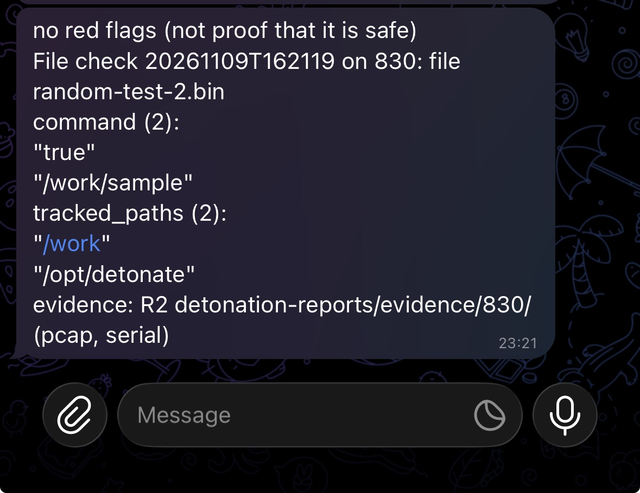
A run takes 25 to 35 s. In file mode, the script first pulls the sample from a
presigned R2 link with curl into /work/sample. Then it starts
/opt/detonate/run-file.sh /work/sample in the same jail. That script is not
in the snapshot clean yet, so the jail runs true in its place, and true
does not execute the sample. The report lists nono’s session data: the
command, the tracked paths, the hosts and the denials.
The Telegram relay
n8n is not on the internet, so a Telegram webhook cannot reach it. The relay
tg-inbox is about 120 lines of Node in one pod. It long-polls getUpdates
(outbound only) and answers only my chat:
- A link to a web page goes to the n8n form.
- A file, or a link whose
HEADsays it is not HTML, is read into memory, hashed with SHA-256 and looked up on VirusTotal. - If VirusTotal returns 404, the relay puts the file in R2 under
samples/<sha256>with a presigned PUT. Then it sends a presigned GET to the form in file mode.
Its egress is the internet minus 10.0.0.0/8, 172.16.0.0/12,
192.168.0.0/16 and 100.64.0.0/10, so a link cannot point it at the LAN.
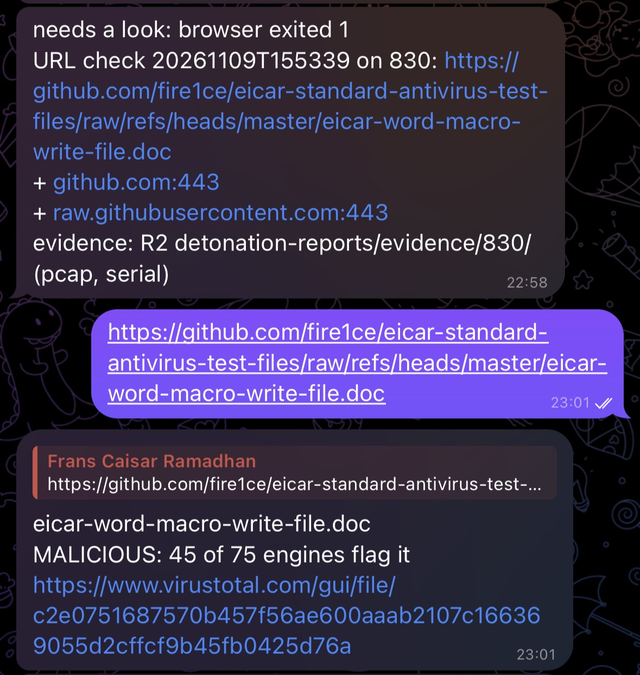
eicar-word-macro-write-file.doc
MALICIOUS: 45 of 75 engines flag it
https://www.virustotal.com/gui/file/c2e0751687570b457f56ae600aaab2107c166369055d2cffcf9b45fb0425d76a
Issue 1: Node Killed at Start
Symptom
node --version inside the jail died with a seccomp kill, syscall=425.
Cause
libuv 1.50 calls io_uring_setup (425). UV_USE_IO_URING=0 does not stop
it, because libuv also uses a ring for epoll. A deny rule
SystemCallFilter=~io_uring_setup:ENOSYS works alone, but next to the allow
list systemd fails with Failed to apply system call filters: Permission denied (status 228/SECCOMP).
Fix
Allow the io_uring calls in systemd, then stack a second filter.
/opt/detonate/enosys uses python3-seccomp with default ALLOW and
ERRNO(ENOSYS) for io_uring_*, then execs the job. With stacked filters,
the stricter result wins, so libuv gets -1 38 and falls back to epoll. V8
then needed pkey_alloc, pkey_free and pkey_mprotect (syscall 330), and
the Chromium zygote needed capset (126). The empty bounding set keeps
capset harmless.
Issue 2: Chromium Refused to Start
Symptom
# lacks support for the sse3 instruction set
Cause
Debian’s chromium wrapper greps /proc/cpuinfo, and ProcSubset=pid
hides it.
Fix
Call /usr/lib/chromium/chromium directly with --no-sandbox, because the
jail blocks the namespaces that the Chromium sandbox needs. Take
--proxy-server=127.0.0.1:<port> from the HTTPS_PROXY value of nono. The
nono proxy accepts loopback without auth. --disable-background-networking
and --disable-component-update cut most of Chromium’s own calls home.
Issue 3: The post-start Hook Never Ran
Symptom
No pcap and no serial log after the first runs.
Cause
On qemu-server 9.2.14 with pve-microvm 0.4.1, Proxmox calls pre-start,
pre-stop and post-stop for a microvm, but never post-start. Then
tcpdump failed with That device is not up, because the tap device’s
operstate stays unknown.
Fix
Start the captures from pre-start with a background waiter that checks the
IFF_UP bit in /sys/class/net/tap<vmid>i0/flags. $! after setsid is not
the capture’s PID, so post-stop uses pkill -f "$d/" on the evidence
directory. A side effect: an SSH command that names that directory gets
killed too, so I run qm stop in its own SSH call.
Issue 4: Samples Do Not Fit Through the Guest Agent
Symptom
agent/file-write failed with larger content.
Cause
The limit sits between 60000 bytes (works) and 80000 bytes (fails).
file-read stops at 16777216 bytes and returns raw bytes.
Fix
Samples go in through a presigned R2 GET that the guest fetches before the
jail starts. Reports come out through file-read, with the screenshot as
base64 inside the JSON.
Issue 5: n8n Could Not Sign Requests to R2
Symptom
The S3 node rejected region auto with Unsupported AWS region, then got 403
because it makes bucket-level calls. The HTTP node with an AWS credential
failed with Missing x-amz-content-sha256, then with Credential service should be s3, not <account id>.
Cause
n8n takes the service name from the first label of a custom host, which for R2 is the account ID.
Fix
n8n does not talk to R2. The hosts upload the evidence with curl, and the relay presigns sample uploads itself with about 20 lines of SigV4. A Code node can also presign, but only with environment access turned on for every workflow, which exposes all n8n secrets. I left that off.
Issue 6: A Download Link Hung for 5 Minutes
Symptom
A link to a .doc file showed “Opening…” and then nothing for 5 minutes.
Cause
Headless Chromium with --screenshot waits for a page that never comes when
the URL is a download. The jail’s RuntimeMaxSec=300 ended it.
Fix
The relay sends a HEAD first. Anything that is not text/html goes to the
hash lookup. The same EICAR test link then came back in seconds.
Issue 7: R2 Answered 403 to the Presigned Links
Symptom
The relay’s presigned PUT and GET both returned 403.
Cause
The R2 secret in OpenBao ends with a newline. The External Secret for the
relay copies the value as it is, so R2_SECRET_ACCESS_KEY keeps the newline,
and the relay signs with a key that R2 does not know.
Fix
The relay trims every environment value at start.
Issue 8: Telegram Rejected the File Report
Symptom
Bad request - please check your parameters from the Telegram node.
Cause
The node sends legacy Markdown, and nono’s key tracked_paths has a bare
underscore.
Fix
Escape _, *, ` and [ in the report and in the LLM summary.
Lessons
- Kill on a blocked syscall. A kill shows up on the serial console,
which the host keeps.
EPERMis quiet and leaves no trace. - Stack seccomp filters when one rule set cannot say it. The stricter
result wins, so a small second filter can return
ENOSYSwhere systemd cannot. - Keep the evidence outside the guest. pcap and serial come from the host, so a sample that owns the VM still cannot clean up after itself.
- Poll when you do not want a public endpoint.
getUpdatesneeds only outbound HTTPS, so n8n stays on the tailnet. - Look before you open. A
HEADrequest decides between the browser and the hash lookup, and it saves a 5-minute hang. - Know what the VM can run. The VMs are Linux. A Windows
.exeor an Office macro does not run there, so for those files the VirusTotal answer is the useful one.
References
- Proxmox: qm manual, hookscripts
- Proxmox: Firewall
- Proxmox: Qemu-guest-agent
- Proxmox: API viewer
- GitHub: rcarmo/pve-microvm
- nono: nono.sh
- GitHub: nolabs-ai/nono
- Linux kernel: Seccomp BPF (SECure COMPuting with filters)
- Linux kernel: Landlock: unprivileged access control
- GitHub: seccomp/libseccomp
- man7: io_uring_setup(2)
- systemd: systemd.exec
- systemd: systemd-run
- Chrome for Developers: Chrome Headless mode
- tcpdump: tcpdump(1)
- curl: curl man page, –aws-sigv4
- AWS: Authenticating requests: Using query parameters (SigV4)
- Cloudflare: R2 presigned URLs
- Cloudflare: R2 object lifecycles
- Telegram: Bot API, getUpdates
- Telegram: Bot API, Markdown style
- VirusTotal: Get a file report
- EICAR: Anti-malware test file
- GitHub: fire1ce/eicar-standard-antivirus-test-files
- n8n: n8n Form Trigger node
- n8n: Security environment variables
- GitHub: wheresryan22/anatomy